

Settings
Reorganized in 4.0
MeshMonitor 4.0 split the old "Settings" tab:
- Global Settings: language, units, appearance, map, security defaults, backup, maintenance. One per deployment.
- Device Configuration: what is written to, or done on, the radio (per source, satellite icon).
- Settings (per source, gear icon): what MeshMonitor stores and does for one source: node display, telemetry, notifications, packet monitor, solar, and the danger zone.
A source's connection details and Virtual Node are edited with Edit Source on the dashboard. Its automations are on its Automation tab. See Multi-Source.
This page covers both the global and the per-source options. An entry with a Location line names the page that holds it.
Open Global Settings from the Global Settings gear icon in the dashboard sidebar footer. Open a source's own Settings from the gear icon in that source's sidebar.
In 4.17, the theme, units, time and date format, sort order and default landing page became install-wide only: a per-source page no longer keeps its own copy of them.
Node Connection Configuration
4.0 — moved to per-source
Changing the address MeshMonitor connects to is now a per-source action. On the dashboard, use Edit Source to change the host and port, MQTT credentials, or MeshCore config for any source. The previous single-node "Change Connection" modal has been replaced by the Sources UI.
The MESHTASTIC_NODE_IP / MESHTASTIC_TCP_PORT env vars only bootstrap the first source on a fresh deployment — after first boot, edit the source.
See Multi-Source → Connection Types for the supported source types (Meshtastic TCP, MeshCore, MeshCore MQTT ingest, embedded MQTT broker, MQTT bridge and Reticulum) and their configuration fields.
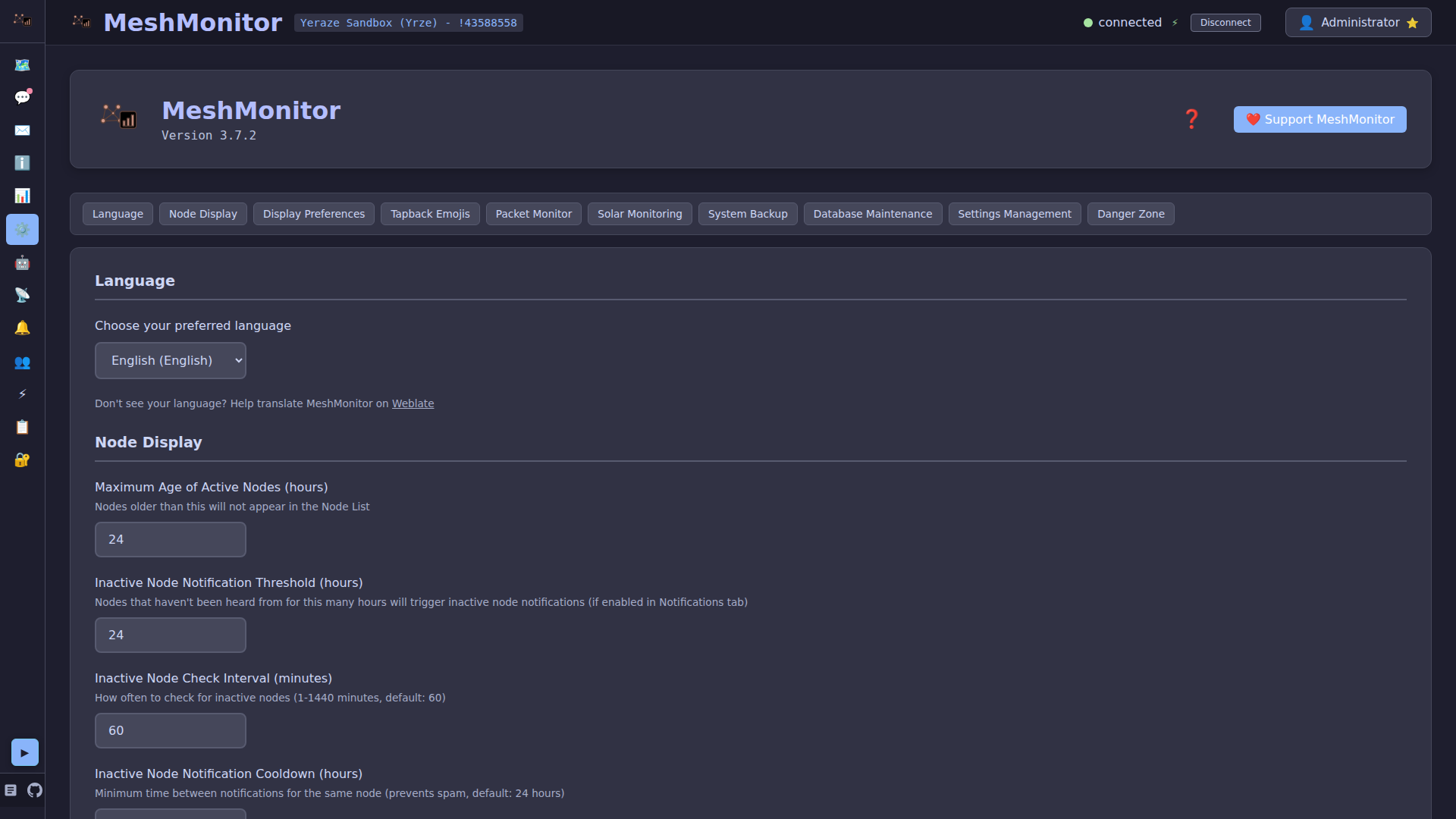
Node Display
Node list & map window
Description: The default time window for the Nodes list and the map. Nodes not heard within it are hidden. The Nodes list header shows the active window (for example Nodes (122) · Setting (last 24h), or Setting (all) at 0). The map's Map age filter can narrow this window but never widen it.
Quick age filter: the window picker in the Nodes list header lets you view a different window (last 24h, 3d, 7d, 30d, or all) without changing this setting. It overrides the setting for the Nodes list and its map, wider or narrower, and only for you: the choice is kept in your browser and never saved to the server. Pick Setting to go back. On MeshCore sources it replaces both the companion and the repeater/room server windows. Background jobs, the Messages tab, and the Dashboard map keep using this setting.
Formerly labeled "Maximum Age of Active Nodes".
Range: 0-720 hours (0 = show all, no age cap)
Default: 24 hours
Effect: Nodes that haven't been heard from in longer than this period will not appear in the Node List. This helps keep the list focused on currently active nodes in your mesh network. Setting the value to 0 disables the cap entirely so every node stays visible, useful for post-mortem review of a mesh you don't intend to prune.
Side Effects: Setting this too low may cause frequently-active nodes to disappear from the list temporarily. Setting it too high (or 0) may clutter the list with offline nodes.
Nodes list header
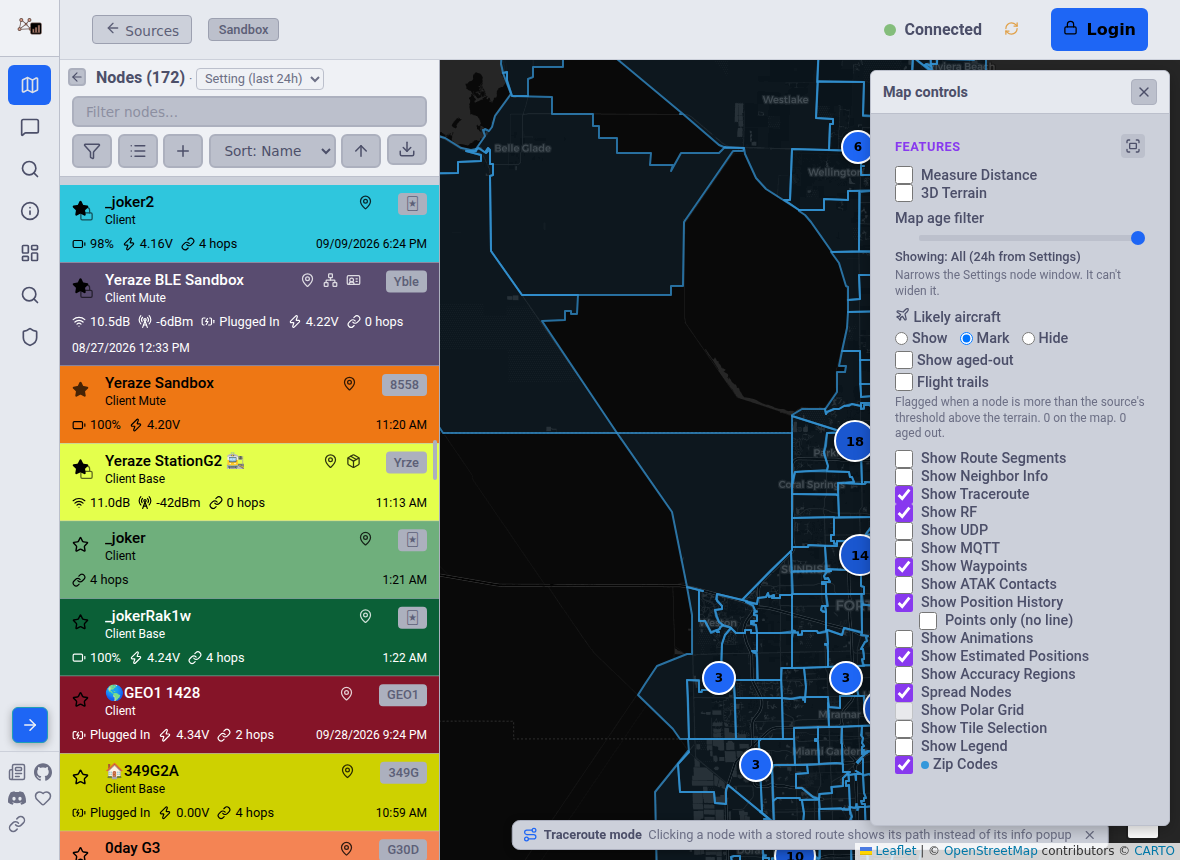
The header holds the title, the age window picker, and one row of icon buttons. Hover over a button to see its tooltip.
- Filter (filter icon, tooltip "Filter nodes"): opens the filter popup described below.
- Group by Role (list icon, tooltip "Group nodes by role"): groups the list by device role. Each group has a header with a count. Click a header to collapse or expand its group. A summary bar shows how the nodes split across roles. Grouping applies to the nodes that pass your filters. Your browser remembers the choice.
- Add node from URL (plus icon): see below. It appears when you view a single source.
Add a node from a contact URL
Paste a https://meshtastic.org/v/#... contact link, the kind Share a Meshtastic Contact creates, and MeshMonitor adds that node to the source. You can then message the node before it sends any packet. MeshMonitor sends nothing over the mesh.
The row shows an Imported badge until the source hears the node. Importing a node the source already knows updates its name and key, and does not add the badge. You need write permission on nodes for that source.
First Heard
MeshMonitor records First Heard for each node on each source. It sets the value once, from the first believable reception, and never overwrites it. You see it in Node Details, in map popups, and in the node export. For nodes that existed before 4.16.2, the upgrade fills it with the earlier of the node's creation time and Last Heard.
Hide Incomplete Nodes
Description: Filters out nodes that haven't been fully verified on secure channels. Incomplete nodes are missing proper name or hardware information, which on encrypted channels indicates we haven't received their NODEINFO packet.
Location: Settings → Node Display, and Filter popup in Nodes/Messages tabs
Default: Disabled (show all nodes)
How it works: A node is considered "incomplete" when it's missing:
- A valid
longName(not just "Node !abc1234" format) - A valid
shortName - A valid
hwModel(hardware model)
Why this matters for secure channels: On channels with custom PSK encryption, NODEINFO packets (containing name and hardware info) are encrypted. If MeshMonitor can't decrypt a node's NODEINFO, we only see default values like "Node !abc1234". This means:
- Complete node = Successfully decrypted NODEINFO = Verified on the same channel
- Incomplete node = No NODEINFO received = May have just overheard encrypted traffic
Effect: When enabled, incomplete nodes are hidden from:
- Node List (Nodes tab)
- Messages tab node list and recipient dropdown
- Filter popup shows checkbox with secure channel recommendation
Auto-behavior: When filtering by a secure channel (custom PSK), the filter popup automatically enables "Hide incomplete nodes" as a recommended default.
Use Cases:
- Secure mesh deployments where you only want to see verified channel members
- Filtering out nodes that may have overheard traffic but aren't on your encrypted channel
- Reducing clutter from unconfigured or unknown devices
Related Settings: See Skip Incomplete Nodes for Auto Acknowledge and Auto Responder to prevent either from responding to incomplete nodes.
Unknown Nodes Filter
Description: Allows you to filter nodes that have no identifying name information. Unknown nodes are those without both a long name and short name, typically displayed as "Node 12345678" in the interface.
Location: Node List filter panel (identified by ❓ icon)
Filter Modes:
- Show only: Display only unknown nodes (useful for identifying devices that need configuration)
- Hide matching: Hide unknown nodes from the list (default behavior, keeps the list clean)
How it works: A node is considered "unknown" when it has no long name AND no short name (or both are empty/whitespace). This commonly happens with:
- Newly added devices that haven't been configured yet
- Devices reset to factory defaults
- Nodes that haven't broadcast their user information
Use Cases:
- Identifying unconfigured nodes in your network
- Cleaning up the node list to show only properly configured devices
- Finding devices that may need attention or setup
Effect: When combined with other filters, this helps manage large mesh networks by focusing on nodes with meaningful identification or highlighting those that need configuration.
Device Role Filter
Description: Filter nodes based on their assigned Meshtastic device role, allowing you to focus on specific types of nodes in your network.
Location: Node List filter panel and Telemetry Dashboard
Filter Modes:
- Show only: Display only nodes with selected roles
- Hide matching: Hide nodes with selected roles from the list
Available Roles:
- CLIENT: Standard end-user devices (most common)
- CLIENT_MUTE: Receives messages but doesn't route
- ROUTER: Dedicated routing nodes
- ROUTER_CLIENT: Routes traffic and used by user
- REPEATER: Dedicated message repeaters
- TRACKER: GPS tracker devices
- SENSOR: Environmental sensor nodes
- TAK: Team Awareness Kit integration
- CLIENT_HIDDEN: Hidden client nodes
- LOST_AND_FOUND: Lost and found trackers
- TAK_TRACKER: TAK-enabled trackers
Use Cases:
- View only routing infrastructure (ROUTER, REPEATER roles)
- Focus on end-user devices (CLIENT roles)
- Monitor specialized nodes (SENSOR, TRACKER roles)
- Analyze network topology by node function
- Create focused views for network management
Effect: Helps organize and analyze large networks by grouping nodes by their functional role in the mesh.
Ignored Nodes Filter
Description: Filter nodes that you have manually marked as "ignored." Ignored nodes are hidden from the node list by default to reduce clutter from nodes you don't want to track.
Location: Node List filter panel (identified by 🚫 icon)
Default: Unchecked (ignored nodes are hidden)
Behavior:
- Unchecked (default): Ignored nodes are hidden from the node list
- Checked: Ignored nodes are shown in the node list
How to Ignore a Node:
- Select a node in the Node List to open its details
- In the Node Details page, click the "Ignore Node" button (next to "Purge Data")
- The node will be marked as ignored and hidden from the list
How to Un-ignore a Node:
- Enable "Show ignored nodes" in the filter panel
- Find the ignored node in the list and select it
- In the Node Details page, click the "Un-ignore Node" button (green button)
- The node will be unmarked and appear normally
Use Cases:
- Hide nodes you're not interested in tracking (e.g., nodes outside your area of interest)
- Reduce clutter in large mesh networks
- Temporarily hide problematic nodes while troubleshooting
- Focus on a subset of nodes that matter to you
Effect: Ignored nodes are hidden from the main Node List by default. They continue to receive data and can be shown again at any time by enabling the "Show ignored nodes" filter. This is a per-node setting stored in the database.
Note: Ignoring a node does not affect message delivery or network functionality - it only hides the node from the UI.
Security Filter
Description: Filter nodes based on detected security issues, allowing you to focus on nodes with security problems or hide them from view.
Location: Filter Modal popup (click the filter icon, tooltip "Filter nodes", in the Nodes list header)
Filter Options:
- All Nodes: Show all nodes regardless of security status (default)
- ⚠️ Flagged Only: Display only nodes with detected security issues
- Hide Flagged: Hide all flagged nodes from the list
Security Issues Detected:
- Low-Entropy Keys: Nodes using known weak public encryption keys
- Duplicate Keys: Multiple nodes sharing the same public key
Use Cases:
- Security audits: View all nodes with potential security vulnerabilities
- Clean view: Hide problematic nodes to focus on trusted devices
- Network monitoring: Quickly identify new security issues as they're detected
- Compliance: Ensure all nodes meet security standards
Visual Indicators:
- Flagged nodes display a ⚠️ warning icon in the node list
- Messages from flagged nodes show a red warning bar with details
- Hovering over warning icons shows specific security issue details
Effect: When "⚠️ Flagged Only" is selected, the node count updates to show "X/Total" format (e.g., "8/156 nodes"). This filter works alongside other filters (text search, device role, unknown nodes) and applies to both Nodes and Messages tabs.
Learn More: See Security Features for detailed information about security monitoring, detection methods, and best practices.
Likely-Aircraft Detection
Description: Flags a node as a likely aircraft (plane, balloon, drone) when its reported altitude sits far above the ground at its position. Flagged nodes get a badge on the map (see Map Features) and can be excluded from Auto-Favorite (see Automation → Auto Favorite).
Location: Settings → Node Display, per source. Meshtastic sources only (including MQTT bridge/broker sources) — MeshCore does not report altitude the same way and is not classified.
Fields:
- Detect likely aircraft — turns classification on or off for this source. Enabled by default.
- Height above ground threshold (m) — the main basis. A node is flagged when its reported altitude is more than this height above the terrain at its position, read from ground-elevation tiles. Default 500 m, range 50–20000 m.
- Fallback: altitude above sea level (m) — used only when terrain elevation is off, or the terrain sample is unavailable, for that node's position. Default 5000 m, range 500–20000 m.
How it works: The height-above-ground basis needs the same ground-elevation data as Elevation / Terrain — outbound tile fetches for classification only happen while that global setting is enabled. When it's off, or a fetch fails, classification silently falls back to the sea-level basis. A warning appears under the thresholds when terrain elevation is off, since only the fallback applies in that case.
To avoid a node flapping in and out of the flag near the threshold, a small hysteresis band protects the exit only: once flagged, a node needs to drop back below the threshold by 10% (minimum 50 m) before it clears. Entering the flagged state still happens exactly at the threshold.
Effect: Saving these settings recomputes existing nodes on this source immediately, from their already-stored altitude and ground elevation — no new tile fetches. Turning detection off clears the flag for every node on the source (the stored ground elevation itself is kept).
Age-out and reclassify as fixed
Aircraft pass through and do not come back, so their nodes pile up. Age-out cleans them up.
Fields (same section, per source):
- Age out likely aircraft — off by default. Needs detection on.
- Age out after (hours) — a flagged node not heard for this long is aged out. Default 24, range 6–168.
- Action — Ignore (default) or Delete.
- Ignore puts the node on the Ignored Nodes list with the reason Aged-out aircraft. This happens in MeshMonitor's database only: nothing is sent to any radio. You can un-ignore it there, or with Un-ignore Node on its Node Details page. An aircraft you un-ignore by hand is not aged out again until it has been heard and then gone quiet once more.
- Delete removes the node and all its history, including positions. It cannot be undone.
- Last run — when the sweep last ran on this source, and how many nodes it aged out, reclassified as fixed, and returned.
How it works: A sweep runs about once an hour for each source. Favorites and the source's own node are never aged out, and a node that is already ignored for another reason is left alone. Saving settings or restarting MeshMonitor does not trigger a sweep.
When an ignored aircraft sends a new live position, its ignore is lifted and it is classified again. This works on MQTT sources too. Manual and geo ignores are never lifted this way, and replayed or retained MQTT frames never lift an ignore.
The same sweep also looks for nodes that were flagged but sit still: a flagged node heard in the last 24 hours with at least 3 position fixes, all within 200 m of each other, is reclassified as fixed. Its flag is cleared and it stays unflagged while it is within 1 km of that spot. If it moves further than 1 km, it is classified normally again. This check runs whenever detection is on, even with age-out off.
Marking a node by hand
The detector can be wrong: a repeater on a mountain top reads as an aircraft, or a drone over a deep valley does not. The node's Actions menu on its Node Details page has three entries to fix this:
- Mark as not aircraft — shown while the node is flagged. Clears the flag and pins the node's current position. The node stays unflagged while it is within 1 km of that spot, the same rule as reclassified as fixed. If it moves further than 1 km, the mark goes away and the node is classified normally again. A node with no known position cannot be marked this way.
- Mark as aircraft — shown while the node is not flagged. Flags the node whatever its altitude says. The mark holds until you clear it. The stationary check above skips the node, but age-out still applies, as for any aircraft.
- Clear aircraft override — shown while the node has a manual mark or a reclassified as fixed mark. Drops the mark and classifies the node again from its stored altitude.
Node Details shows who set a manual mark and when ("Marked as not aircraft · By you on …"), so you can tell it apart from the sweep's own Reclassified as fixed.
The entries need Nodes: write on the node's source, and they do not appear on MeshCore or Reticulum sources or when detection is off for the source. Each change is written to the audit log with the user, node, source and mode. A mark changes MeshMonitor's database only: nothing is sent to the mesh, and it never fires the became likely aircraft automation trigger. Turning detection off for the source clears manual marks along with every other classification.
Ask new aircraft for their position
A node on a slow broadcast interval gives a trail of one or two points before it flies out of range. With Ask new aircraft for their position on, MeshMonitor asks a node for its position when it is first flagged as a likely aircraft: 3 requests, at 0, 2 and 4 minutes, through the source that flagged it.
This is the one aircraft setting that transmits, so it is off by default and set per source.
- Cost: each request is one packet, relayed up to your hop limit, plus the node's reply.
- Limit: at most 2 aircraft an hour per source (6 requests). The count is stored, so a restart or a settings save does not reset it.
- When it stops: if the node is no longer flagged (it landed, or you marked it as not an aircraft), is ignored or deleted, the source disconnects, or a send is refused (TX disabled).
- When it does not fire: for nodes already flagged when MeshMonitor starts, for your own node, and on MQTT, MeshCore and Reticulum sources. A node must stop being flagged and be flagged again before it is asked again.
- Replies: Meshtastic firmware answers a position request at most once every 3 minutes, whoever asks. The request at 2 minutes gets a reply only if the first one did not; the one at 4 minutes is past the limit.
Needs Likely-aircraft detection on. Requests are tagged as automation traffic, so a bridge with Don't uplink MeshMonitor automation traffic keeps them off the upstream broker.
Sign-flipped Position Correction
Description: Some operators type their coordinates without the minus sign, which puts the node on the other side of the globe. This setting shows such a node at its corrected point.
Location: Settings → Node Display, per source (Meshtastic, MQTT, and MeshCore). Off by default.
Options:
- Correct sign-flipped positions: turns the correction on for this source.
- Range: how close a mirror point must be. Default 500 km. Allowed: 10 to 2000 km.
- Reference point (optional): a latitude and longitude to measure from. Leave it blank to use the source's own node. An MQTT source has no node of its own, so it needs a reference point or nothing gets corrected.
How it works: If a node sits outside the range but exactly one mirror of its position (latitude negated, longitude negated, or both) sits inside it, MeshMonitor shows the mirror point. If more than one mirror fits, or none, the node stays where it reported. Node Details then shows "Position auto-corrected (sign flip)" and the coordinates the node reported.
Stored data never changes. The correction only affects what MeshMonitor displays and judges. While it is on, these features use the corrected point:
- Distance-based auto-delete
- MQTT geo-ignore
- Automation geofences
- Traceroute snapshots
- MeshCore contacts
Keep the range small
A wide range can move a real far-away node, for example one heard over MQTT, whose mirror point happens to fall inside it.
Node Details Block
Location: Messages page, displayed when a node is selected in the conversation list
The Node Details block provides comprehensive information about the currently selected node, displaying real-time metrics and device information in an easy-to-read format.
Information Displayed
Node Identification
Node ID (Hex): Node identifier in hexadecimal format (e.g.,
0x43588558)- Standard Meshtastic node ID format
- Used in URLs and API calls
- Matches the format displayed in the Meshtastic app
Node ID (Decimal): Same identifier in decimal format (e.g.,
1129874776)- Useful for debugging and database queries
- Alternative format for different use cases
Power Status
- Battery Level: Current battery percentage (0-100%)
- Color-coded indicators:
- 🟢 Green: >75% (good)
- 🟡 Yellow: 25-75% (moderate)
- 🔴 Red: <25% (low)
- Shows voltage in parentheses (e.g., "85% (4.15V)")
- Color-coded indicators:
Network Quality
Signal (SNR): Signal-to-Noise Ratio in decibels
- Color-coded quality indicators:
- 🟢 Green: >10 dB (excellent)
- 🟡 Yellow: 0-10 dB (good)
- 🔴 Red: <0 dB (poor)
- Color-coded quality indicators:
Signal (RSSI): Received Signal Strength Indicator in dBm
- Shows absolute signal strength
- Lower (more negative) values indicate weaker signal
Signal Trend ▲/→/▼ (New in 4.13): A derived "is this link getting worse?" indicator, distinct from the Link Quality score. It compares the last 24 hours of RSSI (or SNR, when RSSI history is too sparse) against the preceding 7-day baseline: Improving (▲), Stable (→), or Degrading (▼). Hover the badge for the underlying dB deltas. When the drop is attributable to a rising noise floor rather than the link itself, the tooltip calls that out explicitly. Only shown once enough history exists to say something meaningful.
Noise Floor (New in 4.13): The node's self-reported RF noise floor in dBm, shown alongside RSSI/SNR when the device provides it.
Network Performance
Channel Utilization: Percentage of airtime used by all nodes
- Helps identify network congestion
- Values >75% may indicate overcrowded channel
Air Utilization TX: This node's transmission airtime percentage
- Shows how much this specific node is transmitting
- Useful for identifying chatty nodes
Device Information
Hardware Model: Device type with friendly name
- Displays official Meshtastic hardware names (e.g., "STATION G2", "HELTEC V3")
- Shows hardware images when available (70+ device types supported)
- Hardware images fetched from Meshtastic web-flasher repository
Role: Device role in the mesh network
- CLIENT: End-user device (most common)
- CLIENT_MUTE: Receives but doesn't route
- ROUTER: Dedicated routing node
- ROUTER_CLIENT: Routes and used by user
- REPEATER: Dedicated repeater
- TRACKER: GPS tracker device
- SENSOR: Sensor node
- And more specialized roles
Firmware Version: Current Meshtastic firmware version
- Displays version string (e.g., "2.3.2.d1e2f3a")
- Useful for troubleshooting compatibility issues
Network Position
Hops Away: Number of hops from your node
- "Direct": Node is directly reachable
- Number (e.g., "2 hops"): Requires intermediate nodes
Via MQTT: Indicates if node connected via MQTT bridge
- Shows when node is reachable through MQTT instead of radio
Location (New in 4.13)
- Position: The node's latitude/longitude as plain text (5 decimal places) — shown so a bad fix (e.g.
0.00000, 0.00000) is visible at a glance without opening the map - Elevation: The node's reported GPS altitude in meters
Activity
- Last Heard: When the node was last active
- Relative time format (e.g., "5 minutes ago", "2 hours ago")
- Uses your configured time/date format preferences
Layout
The Node Details block uses a responsive grid layout:
- Desktop: 2-column grid for efficient space usage
- Mobile: Single column for better readability on small screens
Missing Data
When information is unavailable, the block displays "N/A" for that metric. This commonly occurs when:
- Node hasn't transmitted certain telemetry data yet
- Information isn't available from the device type
- Connection was lost before all data was received
Traceroute Path
New in 4.13
When the selected node has traceroute data, the Node Details block draws the forward and return paths as a strip of node icons instead of two lines of text.
- Each node in the path renders as a role icon — a tower for a repeater, and similar icons for sensors, room servers, and companion devices — colored by hop count. Hop count follows your Node Hops Calculation setting, the same one that colors the node list and map markers. A node marked unmessagable (it can't receive direct messages) keeps its usual corner badge.
- Each node's short name sits underneath its icon. Hover it, or tab to it with the keyboard, to see its long name, role, and node ID. The card also carries a More Details button that loads that node into the Node Details panel — with the keyboard, press Enter or Space on the node itself. Unknown hops offer no button.
- Arrows connect the nodes and show which way each path runs. The forward path's SNR values sit above the row; the return path's sit below, and its line is dashed. Hover or tap a link to see its direction, both endpoints, the distance between them (in your configured distance unit, shown only when both ends have a position), and the hop's SNR.
- A hop no relay identified itself for shows as a neutral "Unknown" placeholder rather than being skipped, so the path length stays visible. An SNR value the firmware didn't record shows as "?".
Reading the overlap: a node that both the forward and return paths pass through is drawn only once. That single icon is where the two paths meet.
Reading a branch: Meshtastic's flood routing doesn't guarantee the return trip takes the same path as the forward one. When it doesn't, the node(s) that only the return path visits drop to a branch row below the main one, with the return arrow routed through them.
Choosing which traceroute to show: when the node took part in more than one of its 50 most recent stored traceroutes — as an endpoint or as a relay hop (marked "relayed") — a dropdown above the strip lists them by date, endpoints, and hop count. It defaults to the newest. This is also what brings the strip to MQTT sources: they have no node of their own to run traceroutes from, so the strip draws from traceroutes the selected node took part in anywhere on that source's mesh.
Statistical route: on a Meshtastic TCP source, the dropdown gains a Statistical (N routes) entry when two or more stored traceroutes exist between your node and the selected node — all stored history for the pair, not just the 50 the dropdown lists. It merges every route into one diagram: each node and link fades by how often it appeared, so the relays your traffic actually depends on stand out at full strength while one-off detours fade back. Hover any node or link to see the exact count — "Seen in 12 of 16 routes (75%)". The aggregate makes no direction claim, so there are no arrows, no SNR values, and no copy links; pick any dated entry to get the single-route view back. Rare hops never fade below a floor, so they stay visible and hoverable.
The strip scrolls horizontally on narrow screens and uses a smaller size in the split-view side panel. Viewing it needs the traceroute read (or write) permission; requesting a new traceroute still needs write. The "last traced X ago" line and pending/failed badges describe whichever traceroute is displayed.
TIP
This is separate from the Dashboard's Traceroute Widget, which still shows the route as plain text.
Share a Meshtastic Contact
For a node with a stored Meshtastic identity, expand Share contact to create a QR code and a https://meshtastic.org/v/#… URL. Scan the QR code or open the URL in a compatible Meshtastic app to add the node as a contact without waiting for another NodeInfo broadcast.
The contact preserves the node number, names, hardware model, role, public key, licensing status, and messageability status available to MeshMonitor. Unmessagable nodes can still be shared: that flag means the node cannot receive direct messages, not that its contact record is invalid. Contact sharing is separate from channel sharing, which uses Meshtastic's /e/# URL format.
Solar Monitoring
Description: Configure solar production monitoring to visualize expected solar power generation on telemetry graphs.
Integration: Uses the forecast.solar API to fetch solar production estimates based on your panel configuration and location.
Configuration Parameters:
Latitude
- Range: -90 to 90 degrees
- Description: Geographic latitude of your solar installation
- Examples:
- 37.7749 (San Francisco, CA)
- 51.5074 (London, UK)
- -33.8688 (Sydney, Australia)
Longitude
- Range: -180 to 180 degrees
- Description: Geographic longitude of your solar installation
- Examples:
- -122.4194 (San Francisco, CA)
- -0.1278 (London, UK)
- 151.2093 (Sydney, Australia)
Declination (Tilt)
- Range: 0-90 degrees
- Description: The angle your solar panels are tilted from horizontal
- Values:
- 0° = Horizontal (flat mounting)
- 20-40° = Typical roof mount (varies by latitude)
- 90° = Vertical (wall mounting)
- Tip: Use a protractor or angle finder to measure your panel tilt
Azimuth (Compass Direction)
- Range: 0-360 degrees
- Description: Compass direction your solar panels face
- Values:
- 0° = North
- 90° = East
- 180° = South (optimal in Northern Hemisphere)
- 270° = West
- Tip: Use a compass app on your phone to determine panel orientation
Effect: When configured, MeshMonitor will automatically fetch solar production estimates every hour and display them as translucent yellow overlays on telemetry graphs.
Visual Indicator: Solar estimates appear as a yellow background on:
- Node Details telemetry graphs
- Telemetry Dashboard charts
- Any time-series telemetry visualization
Side Effects:
- Hourly API requests to forecast.solar (free tier)
- Additional database storage for solar estimates
- Minimal performance impact on graph rendering
When to use:
- Off-grid or solar-powered Meshtastic deployments
- Battery optimization and planning
- Correlating node performance with available solar power
- Predicting when nodes may go offline due to insufficient power
Learn More: See Solar Monitoring for detailed documentation, API endpoints, and troubleshooting.
Map Settings
Map Click Zoom Gate
New in 4.14.1
Description: The zoom level below which clicking a crowded marker zooms the map in first instead of opening that marker's popup, so you can pick the node you actually meant.
Default: 13 (range 0–18)
Effect: Below this zoom, a click on a marker that has another marker within ~20 screen pixels re-centers and zooms in rather than opening a popup. An isolated marker opens its popup right away at any zoom — crowding is measured per click, so a lone node on the edge of the map is never withheld. Set the value to 0 to turn the gate off entirely and always open popups on the first click.
Raise the threshold if your nodes sit close together and you keep opening the wrong popup; lower it (or zero it) if you mostly view a sparse mesh and want one-click popups when zoomed out.
When Cluster overlapping markers is on, this zoom also sets where clustering stops: below it, crowded markers group into numbered circles. A value of 0 turns off both the gate and clustering.
Location: Global Settings → Map
Cluster Overlapping Markers
Description: Groups crowded map markers into one numbered circle while you are zoomed out below the Map Click Zoom Gate level. Clicking a circle zooms in until its markers split apart.
Default: Enabled
Effect: Turn it off to draw every marker at every zoom, as MeshMonitor did before clustering arrived. The Map Click Zoom Gate keeps working either way, so you can keep the zoom-in-first click behavior without the numbered circles, or drop both.
Clustering makes large node sets much faster to draw. On a busy mesh, expect the map to feel slower with clustering off.
Location: Global Settings → Map
Discard Invalid Positions
New in 4.13
Description: Controls whether GPS fixes reported at Null Island (0, 0) — including precision-obscured positions that snap to that grid cell — are discarded or kept.
Default: Enabled (discard)
Effect: When enabled (default), a (0,0) position is dropped on ingest, across every source, and never stored. Disable it to store and display these positions as received — useful if you want to identify which nodes are transmitting bad/unset GPS fixes. Out-of-range or otherwise garbage coordinates (NaN, outside ±90/±180°) are always discarded regardless of this setting.
Location: Global Settings → Map
Map Tileset Selection
Description: Choose which map tile server to use for displaying your mesh network on the interactive map.
Per-theme selection (New in 4.13)
The tileset is now chosen separately for light and dark appearance — a Light Mode Tileset and a Dark Mode Tileset, each applied automatically when the matching color theme is active. Existing single-tileset selections were preserved for both slots on upgrade.
Default Tilesets:
- OpenStreetMap (default) - Standard OSM map style
- OpenStreetMap HOT - Humanitarian OpenStreetMap Team style
- CartoDB Dark - Dark mode map style
- CartoDB Light - Light mode map style
- OpenTopoMap - Topographic map with terrain details
- ESRI Satellite - Satellite imagery
Location:
- Global Settings: Map section (Light Mode Tileset / Dark Mode Tileset)
- Nodes Tab: Bottom-center tileset selector (visual picker) — updates whichever slot matches your current appearance
Effect: Changes the base map layer displayed on the interactive map. Different tilesets offer different visual styles, levels of detail, and use cases.
Use Cases:
- OpenStreetMap: General-purpose mapping with street and place names
- Satellite: Identify terrain features and physical landmarks
- Topographic: Outdoor deployments needing elevation and terrain data
- Dark/Light: Match your application theme for visual consistency
Custom Tile Servers
Description: Configure custom map tile servers for offline operation, custom styling, or organizational branding.
Features:
- Offline Operation - Use locally hosted tiles without internet access
- Privacy - No third-party requests that could leak node locations
- Custom Branding - Organization-specific map styles
- High Availability - Independence from external tile services
Configuration:
- Navigate to Global Settings → Map → Custom Tile Servers
- Click + Add Custom Tile Server
- Configure:
- Name: Friendly name (e.g., "Local Tiles")
- Tile URL: URL template with
{z}/{x}/{y}placeholders - Attribution: Attribution text for the map source
- Max Zoom: Maximum zoom level (1-22)
- Description: Optional description
- Click Save
- Select your custom tileset from the map tileset dropdown
URL Format: Custom tile servers must use the standard XYZ tile format:
https://example.com/{z}/{x}/{y}.pngRequired Placeholders: {z} (zoom), {x} (tile X), {y} (tile Y)
Optional Placeholders: {s} (subdomain for load balancing)
Supported Formats:
- PNG (
.png) - Best quality, larger file size - JPEG (
.jpg,.jpeg) - Good for satellite imagery - WebP (
.webp) - Smaller file size, modern browsers
Validation:
- Max 50 custom tilesets per instance
- URL length limit: 500 characters
- Name length limit: 100 characters
- Attribution length limit: 200 characters
- Zoom range: 1-22
Security:
- HTTPS recommended for production
- HTTP allowed for localhost/127.0.0.1 only
- Custom tile servers must allow CORS (Cross-Origin Resource Sharing)
Example Configuration:
Name: Local OSM
URL: http://localhost:8080/styles/osm-bright/{z}/{x}/{y}.png
Attribution: © OpenStreetMap contributors
Max Zoom: 18
Description: Offline OpenStreetMap tiles via TileServer GLLearn More: See Custom Tile Servers for detailed setup instructions, TileServer GL integration, and troubleshooting.
Elevation / Terrain (Link Profile)
Description: Controls the digital elevation model (DEM) source that powers the Map Analysis Link Profile tool — the two-point terrain/line-of-sight/Fresnel-zone link-planning tool. Admin-only settings; visible under Global Settings → Elevation / Terrain.
Fields:
- Enable terrain elevation — turns the Link Profile tool's terrain chart on or off. When disabled, the toolbar button disappears from Map Analysis for every user and any in-flight request returns an explicit "disabled" message rather than failing silently. Enabled by default.
- Elevation Source URL — an optional custom DEM source. Leave empty to use the default: the public AWS/Mapzen "Terrarium" tile set (
elevation-tiles-prod.s3.amazonaws.com), a free, no-API-key, SRTM-derived dataset. Treated as a server-side secret (like the Apprise API Server URL) — it's never sent to the browser except back to an admin who already hassettings:write, since it may embed an API key.
Source auto-detection: the URL you enter is auto-detected as one of two shapes:
- A tile-template URL containing
{z},{x}, and{y}placeholders — sampled and decoded the same way as the default Terrarium source. - An Open-Topo-Data-compatible JSON point API — queried in batches instead of tiles.
Test button: probes the configured URL server-side and reports the detected source type, a sample elevation (queried near Mount Everest's summit by default, to distinguish a working provider from a source that just returns 0 for everything), and the round-trip latency — without needing to pick two points on the map first. With the URL field empty, it probes the default Terrarium source and labels the result "(default source)", so you can verify the out-of-the-box configuration too.
Notes:
- All elevation fetches happen server-side through the same SSRF-guarded outbound-request path used elsewhere in MeshMonitor — the browser never talks to the DEM source directly, and a custom source URL can't be used to probe your internal network.
- Elevation data is source-agnostic: it isn't tied to any particular Meshtastic/MeshCore/MQTT source, so this is a single server-wide setting, not a per-source one.
- Implausible DEM samples (below −500 m or above 9000 m — an artifact of open-water/void pixels in some tile sets, not real terrain) are discarded server-side and shown as gaps in the Link Profile chart rather than distorting it.
- The
POST /api/elevation/profileendpoint used by the tool is public (unauthenticated) but rate-limited to 20 requests/minute per IP in production (requests from private/internal IPs are exempt); the Test button's endpoint requiressettings:write.
Also powers the 3D terrain view (New in 4.14)
This same elevation source drives Map Analysis's 3D terrain view. A tile-template URL (the default Terrarium source, or a custom one) works for both the 2D Link Profile chart and the 3D pitched-terrain map. A JSON point API source only supports the 2D Link Profile — there are no tiles to build a 3D surface from, so the 3D toggle stays disabled with an explanatory tooltip for that configuration (no fallback to the default tile source is attempted).
Flight matching (ADS-B)
Description: Looks up a node that becomes a likely aircraft on a free, public ADS-B feed and shows the flight in its popup and details. Admin-only, global (not per source); under Global Settings → Flight matching (ADS-B), next to Elevation / Terrain. Off by default.
Fields:
- Look up likely aircraft on a public ADS-B feed — the on/off switch. Off means no outside calls at all.
- Feed — adsb.lol (default, ODbL open data), adsb.fi (personal, non-commercial use only) or OpenSky Network (non-commercial and research use; needs credentials, below). airplanes.live is not offered in this version.
- API key (optional) — for adsb.lol's announced future key. Sent only when set, never to OpenSky; never shown to non-admins.
- OpenSky client ID / client secret — needed for the OpenSky Network feed (non-commercial and research use only), which takes no anonymous requests. Create an API client on your OpenSky Account page. The OpenSky option stays disabled, and a save is refused, until both are set. Both are server-only and never shown to non-admins.
Two lookups per flagging, then up to six re-checks (at most eight in all); no packets over the mesh. See Flight matching (ADS-B) for how matches are chosen and shown.
Display Preferences
Default Landing Page
New in 4.2.2
Admin-only setting that controls where users land at the root URL (/).
Description: Choose what every user sees when they open MeshMonitor at the root URL — the unified multi-source dashboard, or one specific source's view.
Options:
- Unified View (default) — current behavior; the multi-source dashboard with all sources side-by-side
- Any configured source —
/redirects to/source/:sourceId/so the page opens straight into that source
Location: Global Settings → Appearance → Default Landing Page (admin-only — non-admin users do not see this control).
Effect: Sets a deployment-wide default. Users still have full navigation:
- The Sources button in any source view always returns to the unified dashboard
- The Back to Sources buttons on Unified Messages and Unified Telemetry always return to the unified dashboard
- If the configured source is later deleted or otherwise unreachable, the redirect falls back to the unified view
Use Cases:
- Single-source deployments — bypass the unified dashboard and land users directly on the only source they care about
- Multi-source deployments with a primary node — keep visitors focused on the main mesh while still allowing drill-down into others
Preferred Node List Sorting
Field Options: Long Name, Short Name, ID, Last Heard, SNR, Battery, Hardware Model, Hops
Direction Options: Ascending (A-Z, 0-9, oldest-newest) or Descending (Z-A, 9-0, newest-oldest)
Default: Long Name (Ascending)
Effect: Sets the default sorting for the Node List on the main page. Users can still manually sort the list, but it will return to this default on page reload.
Time Format
Options: 12-hour (e.g., 3:45 PM) or 24-hour (e.g., 15:45)
Default: 24-hour
Effect: Changes how times are displayed throughout the application in messages, telemetry, and other time-based information.
Date Format
Options:
- MM/DD/YYYY (e.g., 12/31/2024)
- DD/MM/YYYY (e.g., 31/12/2024)
- YYYY-MM-DD (e.g., 2024-12-31) - ISO 8601 standard
Default: MM/DD/YYYY
Effect: Changes how dates are displayed throughout the application.
Temperature Unit
Options: Celsius (°C) or Fahrenheit (°F)
Default: Celsius
Effect: Changes how temperature readings from environmental sensors are displayed in telemetry graphs and node details.
Side Effects: Only affects display - the actual telemetry data stored in the database remains unchanged.
Distance Unit
Options: Kilometers (km) or Miles (mi)
Default: Kilometers
Effect: Changes how distances are displayed when viewing node locations and calculating ranges between nodes.
Side Effects: Only affects display - the actual position data remains unchanged.
Color Theme
Description: Customize the visual appearance of MeshMonitor with 15 carefully crafted themes including accessibility-focused options.
Categories:
- Catppuccin (4 themes): Latte, Frappé, Macchiato, Mocha
- Popular Themes (6 themes): Nord, Dracula, Solarized Dark/Light, Gruvbox Dark/Light
- High Contrast (2 themes): WCAG AAA compliant themes for users with low vision
- Color Blind Friendly (3 themes): Optimized for protanopia, deuteranopia, and tritanopia
Default: Catppuccin Mocha (Dark)
Effect: Changes the color scheme for all UI elements including:
- Sidebar and navigation
- Message containers and chat
- Telemetry graphs and charts
- Node information displays
- Settings and configuration panels
- Modals and popups
Accessibility Features:
- WCAG AAA Compliance: High Contrast themes meet the highest accessibility standards
- Color Blind Support: Specialized themes for different types of color blindness
- Persistent Choice: Your theme selection is saved and applies across all pages
- Instant Switching: Themes update immediately without page reload
Learn More: Browse all themes with color previews and detailed descriptions in the Theme Gallery.
Telemetry Visualization Hours
Description: Controls how much historical telemetry data is shown in graphs.
Range: 1-168 hours
Default: 24 hours
Effect: Adjusts the time window for telemetry graphs showing battery levels, voltage, temperature, and other sensor data.
CSV export: Each graph (Node Details and Dashboard favorite charts) includes a download control that exports the currently plotted series for that metric — the same averaged points and display units shown on screen — as a CSV file. Solar overlay and paxcounter Wi‑Fi/BLE columns are included only when those series are present.
Side Effects: Larger values may result in slower graph rendering if you have many nodes with frequent telemetry updates.
Telemetry Dashboard
The Telemetry Dashboard provides customizable monitoring of your mesh network with drag-and-drop widgets. Access it via the Telemetry tab in the main navigation.
Adding Widgets
Click the + button in the dashboard header to add new widgets. Two widget types are available:
Node Status Widget
Description: A table widget for monitoring the status of multiple nodes at a glance.
Features:
- Displays Node Name, Last Heard time, and Hops Away
- Support for multiple nodes in a single widget
- Search functionality to add nodes to the list
- Sort by Last Heard time (most recent first)
- Individual node removal via the × button
Adding Nodes:
- Click in the "Add node..." search field
- Type to filter available nodes by name or ID
- Click a node in the dropdown to add it
- Repeat to add additional nodes
Use Cases:
- Monitor a group of remote nodes at once
- Track when specific nodes were last active
- Identify nodes that may have connectivity issues
- Keep tabs on infrastructure nodes (routers, repeaters)
Traceroute Widget
Description: Displays the last successful traceroute results to and from a selected node, as plain text.
TIP
Looking for the icon-based traceroute strip instead? That's a different surface — the Messages page's Node Details block.
Features:
- Shows the forward path (from your node to the target)
- Shows the return path (from the target back to your node)
- Displays SNR values for each hop when available
- Shows the timestamp of the last traceroute
- Supports a single target node per widget
Selecting a Node:
- Click in the "Select a node..." search field
- Type to filter available nodes by name or ID
- Click a node to display its traceroute information
Information Displayed:
- Forward Path: The route your messages take to reach the target node, showing each hop with signal quality
- Return Path: The route used for return messages, which may differ from the forward path
- SNR (Signal-to-Noise Ratio): Displayed in dB for each hop when available, helping identify weak links
Use Cases:
- Understanding network topology and message routing
- Identifying problematic links in the mesh
- Comparing signal quality across different paths
- Troubleshooting connectivity issues with specific nodes
Widget Management
Drag and Drop: All widgets (telemetry charts, Node Status, and Traceroute) can be reordered by dragging the ⋮⋮ handle in the widget header.
Removing Widgets: Click the × button in the widget header to remove it from the dashboard.
Persistence: Widget configurations (including selected nodes and order) are automatically saved and restored when you return to the dashboard.
Settings Management
Save Settings
Saves all changes made in the Settings tab. Changes are not applied until you click this button.
You can clear a number field while you edit it. A blank or out-of-range field is outlined with a message, and Save stays off until every number is valid.
Side Effects: Settings are stored on the server and will affect all browsers accessing this MeshMonitor instance.
Reset to Defaults
Restores all settings to their default values:
- Max Node Age: 24 hours
- Temperature Unit: Celsius
- Distance Unit: Kilometers
- Telemetry Hours: 24
- Preferred Sort: Long Name (Ascending)
- Time Format: 24-hour
- Date Format: MM/DD/YYYY
Side Effects: This affects all browsers accessing this MeshMonitor instance and cannot be undone.
Danger Zone
These actions are irreversible and can result in data loss. Use with extreme caution.
Erase Node List
Description: Removes all nodes and traceroute history from the database.
Effect: Clears the entire node database and triggers a node refresh to repopulate the list from the connected Meshtastic device.
Side Effects:
- All node information will be permanently deleted
- All traceroute history will be permanently deleted
- The page will automatically refresh after purging
- New nodes will be discovered as they broadcast on the mesh
When to use: When you want to start fresh, have moved to a different mesh network, or need to clean up corrupted node data.
Purge Telemetry
Description: Removes all historical telemetry data from the database.
Effect: Deletes battery, voltage, temperature, humidity, pressure, and other environmental sensor readings.
Side Effects:
- All telemetry graphs will show no historical data
- Current node states (latest battery, voltage, etc.) are preserved
- New telemetry will continue to be collected normally
- The page will automatically refresh after purging
When to use: When your database has grown too large or you want to start fresh telemetry collection.
Clean Telemetry Outliers
Description: Removes bad readings for one metric and keeps the rest of the history. Admin-only.
Location: Settings → Danger Zone → Clean outliers… (sweeps every node on one source), or Clean outliers… in a telemetry chart's menu (checks that one node). See Telemetry outliers.
Effect: Nothing is deleted until you review a preview and confirm. Each purge is written to the audit log.
Purge Messages
Description: Removes all messages from the database.
Effect: Deletes all channel messages and direct message conversations.
Side Effects:
- All message history is permanently lost
- Message search will return no results
- New messages will continue to be received normally
- The page will automatically refresh after purging
When to use: When you need to clear sensitive message history or reduce database size.
Restart Container / Shutdown MeshMonitor
Description: Restarts the MeshMonitor container (Docker) or shuts down the application (bare metal).
Who can use it: Administrators only. The button is disabled for other users. (Changed in 4.17: it used to be open to anyone with settings:write on a source.)
Effect:
- Docker: The container restarts automatically and will be unavailable for approximately 10-30 seconds
- Bare Metal: MeshMonitor shuts down and must be manually restarted
Side Effects:
- All active connections will be disconnected
- The web interface will be temporarily unavailable
- Running background tasks (traceroutes, announcements) will be interrupted
- After restart (Docker only), the page should reload automatically
When to use: When applying configuration changes that require a restart, troubleshooting connection issues, or performing maintenance.
Related Documentation
- HTTP vs HTTPS Configuration - Learn about the
COOKIE_SECUREsetting for authentication - Production Deployment - Best practices for production environments
- Reverse Proxy - Configure NGINX, Traefik, or Caddy